






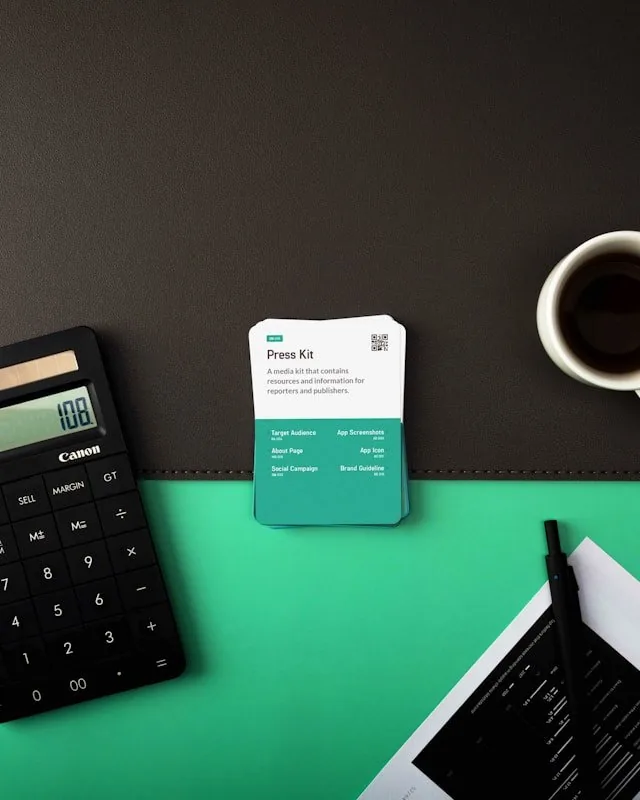
A media kit is a single place where a journalist can get everything they need to write about you without emailing to ask. In practice they use four things from it — the boilerplate, a high-resolution logo, an executive headshot, and the spelling of names and titles. Everything else in a typical kit exists for internal reasons. Build the four properly, host them where they can be reached without a form, and the rest is optional.
Two different things get called a media kit. This page is about the press kit — assets for journalists. If you are looking for an advertising or sponsorship media kit, that is a sales document with audience demographics and rate cards, and almost none of this applies.
What journalists actually use
In rough order of how often it is genuinely needed:
1. Boilerplate. Two or three sentences describing the company, written so it can be pasted into the final paragraph of an article unchanged. Most kits get this wrong by making it four sentences of positioning.
2. Logo, high resolution, transparent background. PNG and SVG. Publications will not chase you for this — they will crop something off your website and it will look bad.
3. Executive headshots. High resolution, neutral background, recent. One landscape and one portrait crop of each, because you do not control the layout.
4. Exact spellings and titles. Founder names, product names, capitalisation, whether your company takes "the". Trivial, constantly wrong, and the thing corrections get issued for.
Everything after this point is used occasionally:
Product screenshots or photography, at print resolution.
Key facts — founding year, headquarters, headcount range, funding total, customer count. Dated, so a reporter knows how current it is.
Recent coverage, five or six links, which saves a journalist working out whether the story has been done.
A one-paragraph company description at three lengths — 25 words, 50 words, 100 words. Genuinely useful and almost nobody provides it.
What does not belong
Your brand guidelines. Nobody outside your company will follow them.
A mission statement. It will not be quoted.
Marketing copy of any kind. A journalist writing about you is not persuadable by the same material that persuades a buyer, and its presence signals you do not understand the difference.
A gated form. The single most common mistake. A reporter on deadline will not fill in a form to get your logo. They will use whatever they can find.
Video, unless it is genuinely relevant. It is large, rarely used, and slows the page.
Awards. Unless the award is the story.
Format and hosting
A web page, not a PDF. A PDF cannot be linked into, cannot be updated without redistributing, and cannot be found by search. A permanent URL at /press or /newsroom is the correct answer.
No login, no form, no email gate.
Direct download links for every asset, plus a single zip for everything.
A date stamp. "Last updated August 2026" tells a reporter whether the headcount figure is worth using.
A named contact with a real phone number. Somebody who answers.
Keep the PDF as a secondary option if you want one for email attachments, but the page is the canonical version.
The part most kits are missing
A media kit is a passive asset. It answers questions from journalists who have already decided to write about you. That is genuinely useful, and it is not what produces coverage.
Between December 2025 and August 2026, 63% of graded replies to our direct outreach were a yes. None of that came from a media kit. The kit made those conversations faster once they started.
"When a reporter does reply, 63% of the time it's a yes. The hard part was never convincing them. It's getting read at all."
Justin Mauldin, Founder, Salient PR
The practical implication: build the kit once, keep it current, and do not treat building it as PR activity. It is infrastructure.
Keeping it current
The most common failure is not a missing kit. It is a kit that says 40 employees when you have 200, or lists an executive who left last year.
"We keep 1,750 reporters in the database and the maintenance never stops. People move outlets, change beats, leave the industry. A list that hasn't been touched in six months is mostly wrong."
Kristin Kaplan, Operations, Salient PR
The same is true of your own facts. Review it quarterly, and always after a funding round, an executive change or a rebrand. Put a date on the page so a reporter can judge for themselves.
Media kit versus press release versus pitch
| Media kit | Press release | Pitch | |
|---|---|---|---|
| Purpose | Supply assets and facts | State something on the record | Propose a story |
| Audience | A journalist already writing | Anyone, on the record | One named journalist |
| When used | After interest exists | At announcement | To create interest |
| Length | A page plus downloads | 400–600 words | Under 150 words |
| Produces coverage | No | Rarely | This is what does |
Does AI search change what belongs in a kit?
Modestly, and in a useful direction.
AI systems assembling an answer about a company pull from structured, dated, factual sources. A press page with clear facts — founded, headquartered, headcount, funding, named executives with titles — is close to the ideal format for that, and better than the same information scattered across an About page and three blog posts.
A peer-reviewed study of generative-engine optimisation (KDD 2024) found that adding direct quotations, statistics and cited sources measurably improved how often a page was surfaced in generative answers — by up to 40% on the authors' benchmark, with the size of the effect varying by subject area. So the key-facts section, which most companies treat as an afterthought, is now the part with the longest life.
One practical change: date everything. A figure with a date attached is more likely to be used and less likely to be repeated long after it stops being true.
The checklist
- Boilerplate, two or three sentences, pasteable
- Logo: PNG and SVG, transparent, high resolution
- Executive headshots, landscape and portrait, recent
- Exact spellings, titles and capitalisation
- Key facts with a date on them
- Company description at 25, 50 and 100 words
- Five or six recent coverage links
- Product imagery at print resolution
- A named contact who answers a phone
- Hosted at a permanent URL, no form, no gate
- "Last updated" date visible
- Reviewed quarterly
The short version
- Journalists use four things: boilerplate, logo, headshots, exact spellings.
- Host it as a page, not a PDF. No form, no gate, no login.
- Date your facts. A stale headcount is worse than no headcount.
- A media kit answers questions from people already writing about you. It does not create interest — outreach does.
- Build it once, review it quarterly, and stop counting it as PR activity.
Salient PR runs earned media programmes for technology companies. Outreach figures come from our own database covering December 2025 to August 2026.
Sources
- Salient PR outreach database, Dec 2025 – Aug 2026
- Aggarwal et al., GEO: Generative Engine Optimization, KDD
If you want a media kit built around what reporters actually open — Salient PR is a technology PR agency working with technology companies. See how we work or start a conversation.
Related reading
About Salient PR
Salient is a B2B tech PR agency. We help startups become the story — landing tier-one coverage, building executive visibility, and turning attention into pipeline.
Senior team. No hand-offs. Radical transparency. If you’re ready to talk, reach out.
What belongs in a media kit, what journalists actually open, and why most kits are built for the wrong audience. With a checklist and format guidance.