














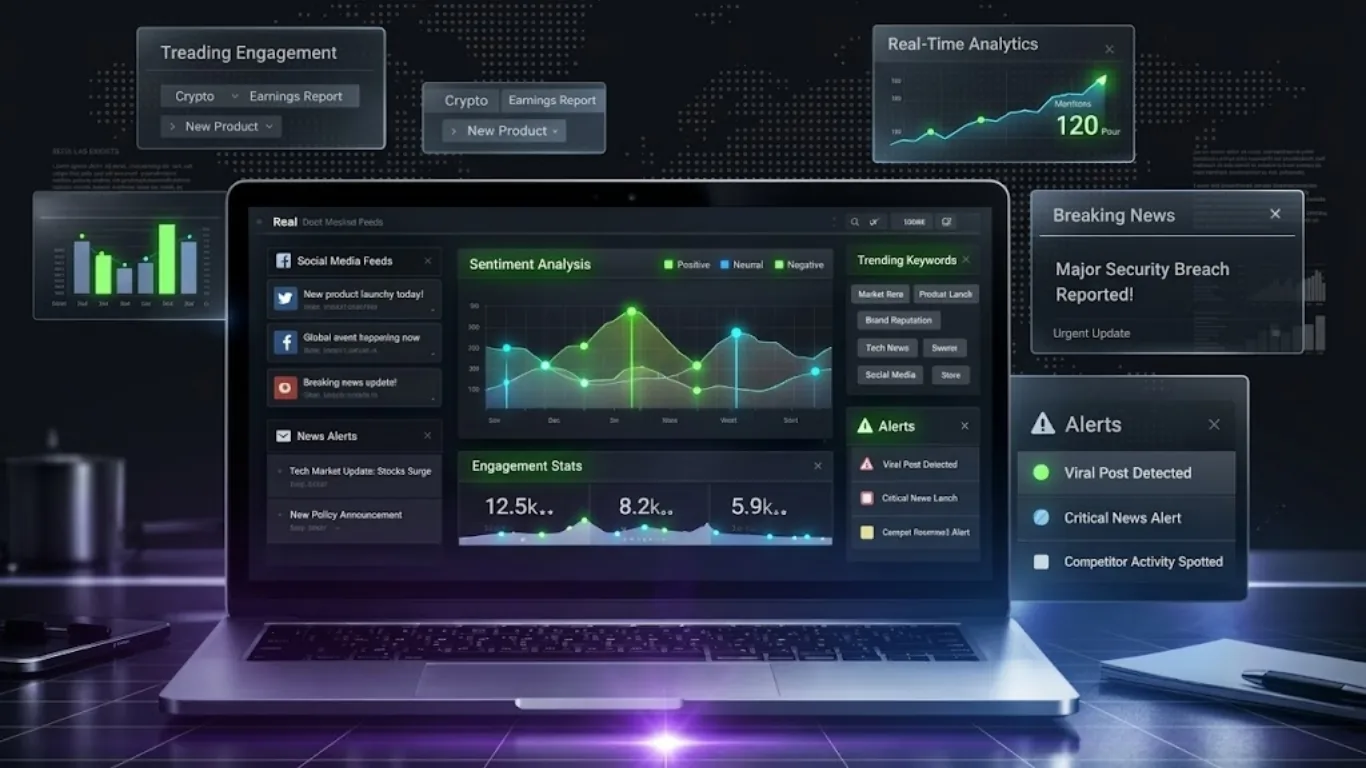
Media monitoring tools tell you when your company gets mentioned. The category ranges from free alerts to platforms costing thousands a month, and the honest answer for most companies is that you need less than you think. Below roughly five mentions a month, free alerts plus a weekly manual check is genuinely sufficient. Paid monitoring earns its cost once you have consistent weekly coverage, multiple markets, or a compliance reason to capture everything.
What these tools actually differ on
Feature lists look identical across vendors. The real differences are four:
Source coverage. Whether it indexes trade press, broadcast, podcasts and print, or mostly web. Trade coverage is where most B2B mentions land and it is where cheap tools are weakest.
Latency. Hours versus days. Matters enormously in a crisis and barely at all otherwise.
Syndication handling. One press release can generate 200 near-identical republications. A good tool groups them. A bad one sends you 200 alerts and calls it coverage.
Sentiment and analysis. Usually oversold. Automated sentiment is unreliable at the level of nuance PR actually cares about, and below a few hundred mentions a month you can simply read them.
The categories
Free. Google Alerts, RSS feeds, native social search. Misses trade press, misses paywalled content, misses broadcast, and has notable latency. Adequate for low volume and genuinely useful as a supplement even when you pay for something.
Low-cost web monitoring. Tools like Brand24 and Mention. Good web and social coverage, weaker on trade and print. Sensible first paid step.
Full PR suites. Cision, Meltwater, Muck Rack, Prowly, Onclusive. Broadest source coverage, bundled with media databases and reporting. Meaningfully more expensive, and you are usually paying for the database as much as the monitoring.
Specialist and regional. Local providers often beat the incumbents on specific markets or languages. Worth checking if you operate outside major English-language markets.
What to test before buying
Do not run the vendor's demo. Run this instead.
Search for coverage you already know about. Pick five mentions from the last six months, including one in a trade publication and one behind a paywall. See how many the tool finds.
Check a syndicated release. If you have distributed a wire release, see whether the tool groups the republications or lists them individually. This single test predicts how much time the tool will waste.
Time a fresh mention. How long between publication and alert.
Ask what it does not index. Every vendor has gaps. The ones that answer honestly are the ones worth buying from.
What monitoring is actually for
Three legitimate uses, and one illegitimate one.
Reacting fast. A journalist has written something inaccurate and you have a window to correct it.
Finding the next pitch. A reporter covering your category is a warm lead. Monitoring tells you who is writing about what right now.
"Before anything goes out I check whether the reporter has written about the category in the last 90 days. If they haven't, they come off the list. That one rule kills more pitches than any editing pass."
Lindsey Ranger, Account Lead, Salient PR
Recording what happened. So the programme learns rather than repeats.
The illegitimate use: volume reporting. Counting mentions as a performance metric rewards syndication and press releases, which are the two things that produce the most mentions and the least value. If your monitoring tool is generating a monthly number that goes in a board deck, check what is actually in it.
What it costs
| Tier | Rough monthly | Suits |
|---|---|---|
| Free | $0 | Under ~5 mentions/month |
| Web monitoring | $50–$300 | Consistent coverage, web-first |
| Mid-tier suite | $500–$1,500 | Trade press matters, multiple markets |
| Enterprise suite | $2,000+ | Broadcast, print, compliance, global |
Pricing in this category is negotiable and rarely published. Expect annual contracts and ask about the renewal increase before you sign.
Where monitoring fits in the wider stack
Monitoring is the third thing you need, not the first. Finding the right journalist and being able to send reliably both matter more.
For context on what that looks like: between December 2025 and August 2026 we recorded a 1.0% bounce rate and zero unsubscribes. Monitoring told us what happened afterwards; it did not produce any of it.
"Ask for the last 20 pitches they sent in your category and what came back. Not case studies, not a logo wall. The actual sends. If they can't produce that, they aren't measuring, and you'll find out in month four."
Justin Mauldin, Founder, Salient PR
Does AI search change media monitoring?
It adds a category nobody's tool covers well yet: what AI systems say about you.
Increasingly your buyers ask an assistant about your company before they reach your website, and that answer is assembled from published sources. Traditional monitoring does not capture it. The practical workaround is manual — query the major assistants about your company and category monthly, and record what comes back. It takes twenty minutes and tells you something no monitoring dashboard currently will.
The short version
- Under five mentions a month, free alerts are genuinely enough.
- Judge tools on source coverage, latency, and whether they group syndication.
- Test with coverage you already know about, not the vendor's demo.
- Automated sentiment is oversold. Below a few hundred mentions, read them.
- Do not report mention volume as performance. It rewards the wrong activity.
- Add a manual monthly check of what AI assistants say about you. No tool does it yet.
Salient PR runs earned media programmes for technology companies. We have no commercial relationship with any tool named on this page. Outreach figures come from our own database covering December 2025 to August 2026.
Sources
- Salient PR outreach database, Dec 2025 – Aug 2026
If you want monitoring set up and actually read — Salient PR is a technology PR agency working with technology companies. See how we work or start a conversation.
Related reading
About Salient PR
Salient is a B2B tech PR agency. We help startups become the story — landing tier-one coverage, building executive visibility, and turning attention into pipeline.
Senior team. No hand-offs. Radical transparency. If you’re ready to talk, reach out.
Which media monitoring tools are worth paying for, when free alerts are enough, and what the categories actually differ on. Written by a working PR agency.